XX. [3] But the oldest sanctuary of Dionysus is beside the theatre (1). Within the enclosure there are two temples and two images of Dionysus (2), one surnamed Eleutherian, the other made by Alcamenes of ivory and gold. Here, too, are pictures representing Dionysus bringing Hephaestus up to heaven (3). For the Greeks say that Hera flung Hephaestus down as soon as he was born, and that he, bearing her a grudge, sent her as a gift a golden chair with invisible bonds (4). When Hera sat down on it she was held fast, and Hephaestus would not listen to the intercession of any of the gods, till Dionysus, his trustiest friend, made him drunk, and so brought him to heaven. There are also depicted Pentheus and Lycurgus suffering retribution (5) for the insults they offered to Dionysus, and Ariadne asleep, and Theseus putting to sea (6), and Dionysus come to carry Ariadne off.
[4] Near the sanctuary of Dionysus and the theatre is a structure said to have been made in imitation of the tent of Xerxes (7). It was rebuilt, for the old edifice was burned by the Roman general Sulla when he captured Athens [...].
XXI. [1] In the theatre at Athens (8) there are statues of tragic and comic poets (9), but most of the statues are of poets of little mark. For none of the renowned comic poets was there except Menander (10). Among the famous tragic poets there are statues of Euripides and Sophocles (11). It is said that after the death of Sophocles (12) the Lacedaemonians had invaded Attica, and that their general saw Dionysus standing by him and bidding him to pay to the new siren the honours which are customarily paid to the dead ; and it seemed to him that the dream referred to Sophocles and his poetry ; for to this day whatever is winsome in verse and prose they liken to a siren.
[2] The statue of Aeschylus was made, I think, long after his death and long after the painting of the battle of Marathon. Aeschylus said that, when he was a stripling, he fell asleep in a field while he was watching the grapes, and that Dionysus appeared to him and bade him write tragedy ; and as soon as it was day, for he wished to obey the god, he tried and found that he versified with the greatest ease. Such was the tale he told.
[3] On what is called the south wall of the Acropolis, which faces towards the theatre, there is a gilded head of the Gorgon Medusa (13), and round about the head is wrought an aegis. At the top of the theatre is a cave in the rocks under the Acropolis (14) ; and over this cave is a tripod. In it are figures of Apollo and Artemis slaying the children of Niobe. This Niobe I myself saw when I ascended Mount Sipylus (15). Close at hand it is merely a rock and a cliff with no resemblance to a woman, mourning or otherwise ; but if you stand farther off, you will think you see a weeping woman bowed with grief.
Translated with a commentary by J.G. Frazer - Macmillan and co, London (1913)
NOTES
(1) The oldest sanctuary of Dionysus is beside the theatre. The situation of the theatre at the south-eastern foot of the Acropolis is well known. The sanctuary of Dionysus here described by Pausanias lay immediately to the south of the theatre, at the back of the stage buildings, for here have been found the remains of the two temples mentioned by our author. The existence of a sanctuary of Dionysus beside the theatre is noticed also by Vitruvius (V. 9) ; and we are told by Marinus (Life of Proclus, 29) that the philosopher Proclus had a house between the sanctuary of Dionysus at the theatre and the sanctuary of Aesculapius, which, as we know, was situated at the southern base of the Acropolis, immediately to the west of the theatre. An ornamental gateway or portal led into the precinct. For Dioclides, who gave evidence as to the sacrilegious mutilation of the Hermae which created such consternation in Athens on the eve of the sailing of the Sicilian expedition, described how, rising one morning before daybreak to go to Laurium, he came to the portal of Dionysus and there by the light of a full moon saw a crowd of men coming down from the Music Hall into the orchestra. Full of fear and awe he entered the precinct and, crouching down in the shadow between a pillar and a bronze equestrian statue, beheld how the men, about three hundred in number, divided themselves into bands of fives, tens, and twenties, and danced in the moonlight, which fell so full on their faces that he recognised most of them. Next day he heard that the Hermae had been mutilated, and he made sure that the men he had seen dancing by moonlight in the orchestra were the criminals. See Andocides, I. 38 sq.
Until lately it has been customary to identify this sanctuary of Dionysus at the theatre with (1) the sanctuary of Dionysus in the Marshes, and (2) the Lenaeum (sanctuary of Lenaean Dionysus), which have been regarded as identical with each other.
- The sanctuary of Dionysus in the Marshes is mentioned by Thucydides (II. 15) along with the sanctuaries of Olympian Zeus, the Pythian Apollo, and Earth, as proof that ancient Athens, so far as it exceeded the limits of the Acropolis, lay chiefly to the south of it. Thucydides adds that the more ancient festival of Dionysus was celebrated at this sanctuary in the Marshes on the 12th day of the month of Anthesterion (February-March). Thus from Thucydides we learn that the sanctuary of Dionysus in the Marshes lay to the south of the Acropolis. Further, we know that it was within the city-walls ; for Isaeus tells us (VIII. 35) that a certain Ciron owned a farm at Phlya and two houses in the city, of which one, rented at 2000 drachms, was beside the sanctuary of Dionysus in the Marshes. The pseudo-Demosthenes (LIX. 76, p. 1371) speaks of this sanctuary as the oldest and holiest sanctuary of the god in Athens ; it was opened, he tells us, only once a year, namely on the 12th of Anthesterion, the day when the ancient Dionysiac festival was held. On this day, known as the Feast of Pitchers (Choes), people brought to the priestess in the sanctuary at the Marshes the garlands which they had worn; after which they offered sacrifices in the sanctuary (Athenaeus, X. p. 437 b-d). They also brought the new wine in jars and offered some of it to the wine-god at his sanctuary in the Marshes ; then they quaffed it themselves (Athenaeus, XI. p. 465 a). But this presentation of the new wine could hardly have taken place in Anthesterion (February-March) ; the natural time for it would be in autumn. It is not said that the presentation took place inside of, but only at or beside (pros) the sanctuary. There was an altar in the sanctuary, and beside the altar stood a stone pillar or slab, on which was engraved a law ordaining that the Queen, the wife of the republican magistrate called the King, must be a burgess and a virgin when she married her husband ([Demosthenes] LIX. p. 1370). Beside this altar the Queen administered an oath of chastity and ceremonial purity to the fourteen women who assisted her in her priestly functions ([Demosthenes,] LIX. pp. 1369-1372 ; Hesychius and Harpocration, s.v. gerarai). Aristophanes refers to the croaking of the frogs at this sanctuary of Dionysus in the Marshes at the feast of the Holy Pots (Frogs, 215 sqq.) Cp. Schol. on Aristophanes, Frogs, 216, 218, 219 ; Stephanus Byzantius and Photius, Lexicon, s.v. Limnai ; Harpocration, s.v. en Limnais Dionusion. As to the festival on the 12th of Anthesterion, see Aug. Mommsen, Heortologie, p. 356 sqq.
- The Lenaeum is described as a large enclosure containing a sanctuary of Dionysus in which dramatic exhibitions were given before the theatre was built (Hesychius, s.v. epi Lênaiô ; Photius, Lexicon, s.v. Lênaion ; Etymolog. Magnum, p. 361, s.v. Epilênaiô ; Bekker's Anecdota Graeca, 1. p. 278, line 8 sq.) The comedies of Pherecrates seem to have been acted here (Plato, Protagoras, p. 427 d). The situation of the Lenaeum is not known. Hesychius says (s.v. epi Lênaiô agôn) that it was in the city ; but the scholiast on Aristophanes (Acharn. 202 and 504) says that it was in the fields. This statement of the scholiast appears to be merely an inference drawn by him from the two lines of Aristophanes on which he is commenting ; but the lines seem certainly to justify the inference that the festival of Lenaean Dionysus was held in the country. This indeed we should expect to be the case, since the epithet Lenaean designates Dionysus as the god of the wine-press (lenos), and wine-presses are usually to be found beside the vineyards, not in cities (cp. Apollodorus, cited by Stephanus Byzantius, s.v. Lênaios). Further, the distinction between «the Dionysiac festival in the city» and «the Dionysiac festival at Lenaeum» (C.I.A. II. No. 741 ; Dittenberger, Sylloge Inscr. Graec. No. 374) points to the latter being a rural festival. On the other hand, there is a piece of evidence which seems to confirm Hesychius's statement that the Lenaeum was in the city. In a well-known passage (XVIII. 129, P. 270) Demosthenes taunts his rival Aeschines with the meanness of his birth. The mother of Aeschines, says Demosthenes, was a common prostitute who plied her trade in a brothel beside the sanctuary of the hero Calamites ; and from another source (Hesychius, s.v. kalamitês) we learn that the sanctuary of this otherwise unknown hero was beside the Lenaeum. If, then, the neighbourhood of the Lenaeum was a haunt of prostitutes, it is more likely to have been in the town than the country.
The questions still remain : (1) Was the Lenaeum identical with the sanctuary of Dionysus in the Marshes ? and (2) Were these sanctuaries, or, supposing them to be different, was one of them, identical with the sanctuary of Dionysus at the theatre ?
- The first question has been generally answered in the affirmative. But the only positive evidence for identifying the Lenaeum with the sanctuary of Dionysus in the Marshes appears to be a statement of Hesychius (s.v. Limnai) that the Marshes (Limnai) was a place in Athens dedicated to Dionysus where the Lenaean festival was held. A difficulty in the way of identifying them is that the sanctuary in the Marshes is said to have been opened only on the festival of the 12th of Anthesterion (see above) ; whereas the Lenaean festival appears to have been celebrated in the Lenaeum in the month Gamelion (Aug. Mommsen, Heortologie, p. 332 sqq.) The distinction of the two sanctuaries is maintained by Mr. G. Oehmichen (Sitzungsberichte d. k. bayer. Akad. d. Wissen. zu München, Philosoph. philolog. Cl. 1889, vol. 2, p. 122 sqq.)
- There are some grounds for identifying the sanctuary at the theatre with the sanctuary of Dionysus in the Marshes. The situation of the latter sanctuary to the south of the Acropolis and within the citywalls (see above) answers perfectly to the situation of the sanctuary at the theatre. Again, the sanctuary at the theatre is stated by Pausanias to have been the oldest sanctuary of Dionysus ; and the same statement is made of the sanctuary in the Marshes by the pseudo-Demosthenes (LIX. 76, p. 731) explicitly and by Thucydides (II. 15) implicitly. Prof. von Wilamowitz - Möllendorff, indeed, thinks that Pausanias merely copied from, and mistook, Thucydides, applying to the sanctuary at the theatre a statement which Thucydides made about the sanctuary in the Marshes, which, according to Prof. von Wilamowitz-Möllendorff, was in a different part of Athens (Hermes, 21 (1886), p. 621). But the contents of the sanctuary at the theatre bear out Pausanias. For here was the temple of Dionysus of Eleutherae, whose worship was the first introduced into Athens (see I. 2. 5 ; I. 38. 8). The difficulties in the way of identifying the sanctuary at the theatre with the sanctuary in the Marshes are that the situation of the sanctuary at the theatre is high and arid, not at all marshy ; and that the sanctuary in the Marshes was opened only on the 12th of Anthesterion, whereas the sanctuary at the theatre must have been opened in the month Elaphebolion on the occasion of «the Dionysiac festival in the city» (A. E. Haigh, The Attic Theatre, p. 10 sq.)
The only ground for identifying the sanctuary at the theatre with the Lenaeum would seem to be that the latter is said to have been the scene of dramatic exhibitions before the theatre was built, and it is not unnatural to suppose that the theatre was built on the site where the dramatic exhibitions had previously been held. On the other hand the difficulty in the way of identifying the sanctuary at the theatre with the Lenaeum is that we should then have to suppose that «the Dionysiac festival in the city» and «the Dionysiac festival at Lenaeum» were celebrated at the same place, contrary to the apparent signification of the names.
On the whole it would seem that the question of the difference or identity of the sanctuaries of Dionysus at the theatre, in the Marshes, and at the Lenaeum must remain for the present in suspense. Dr. Dörpfeld formerly held that the sanctuary in the Marshes was in the northwestern quarter of Athens between the market-place and the Dipylum (Berliner philolog. Wochenschrift, 10 (1890), p. 461) ; and this view has been supported at great length by Mr. J. Pickard (American Journal of Archaeology, 8 (1893), pp. 56-82), but his arguments are not convincing. Prof. E. Maass argues that the Lenaeum, which he identifies with the sanctuary of Dionysus in the Marshes, was in the market-place (De Lenaeo et Delphinio Commentatio, p. v. sqq.) Dr. Dörpfeld now (1894) believes that he has discovered the Lenaeum (which he identifies with the sanctuary of Dionysus in the Marshes) at the western foot of the Acropolis, to the south of the Areopagus. In the course of excavations conducted here he has found an enclosure about 40 metres long by 20 metres wide, surrounded by ancient polygonal walls. Inside the enclosure were found numerous fragments of large black-figured and red-figured vases, the lover part of an altar or table of stone, and a Greek wine-press. Hence he believes that the enclosure was the Lenaeum. The remains of a Roman building, which from an inscription appears to have been the place of assembly of a Dionysiac society, were found immediately over the supposed Lenaeum, which was buried under them. Dr. Dörpfeld supposes that in Roman times the worship of Lenaean Dionysus fell into neglect, and was replaced by the Dionysiac society which built its meeting-house or club-room immediately over the ancient sanctuary. See Dr. Dörpfeld, in Mittheil. d. arch. Inst. in Athen, 19 (1894), pp. 147-150. Cp. Leake, Athens, I. pp. 287-289 ; Dyer, Ancient Athens, p. 305 sq. ; Wachsmuth, Die Stadt Athen, 1. p. 243 ; Milchhöfer, Athen, p. 189 ; von Wilamowitz-Möllendorff, in Hermes, 21 (1886), p. 615 sqq. ; Lolling, Athen, p. 327; W. Judeich, «Lenaion», Rheinisches Museum, N. F. 47 (1892), pp. 53-60.
(2) Two temples and two images of Dionysus etc. Remains of two small temples, doubtless the temples here mentioned by Pausanias, have been found immediately to the south of the stage-buildings of the Dionysiac theatre. The older of the two temples abuts on the south wall of the stage building at its western end. All that remains of this temple is a portion of the north wall and two small pieces of wall at right angles to it. It is orientated east and west. It must have been very small. From the style of the masonry and of the clamps it appears that the temple is older than the Persian wars. This was probably the temple in which the image of Eleutherian Dionysus stood. The image seems to have been the ancient wooden one which, according to tradition, was brought to Athens from Eleutherae (I. 38. 8) by Pegasus (I. 2. 5). Every year on stated days the image was conveyed to a small temple near the Academy (I. 29. 2). The temple was once burnt down (Clement of Alexandria, Protrept. IV. 53, p. 47, ed. Potter). The chief seat in the neighbouring theatre (a richly-carved arm-chair of marble in the middle of the front row) was set apart for the priest of Eleutherian Dionysus, as we learn from the inscription on it (C.I. A. III. No. 240).
A few feet due south of this temple, and about 46 feet south of the western end of the stage-building, are the remains of the other temple. It is larger in size and later in style than the one just described, and its orientation is somewhat different. Its length is about 75 feet and its width 33 feet. The foundations, which alone remain, are built of breccia stone. The temple consisted of a cella with a fore-temple or ante-chamber. In the cella are the foundations of a large base, which probably supported the golden and ivory image of Dionysus, the work of Alcamenes. Dr. Dörpfeld has pointed out that none of the buildings of the age of Pericles has foundations of breccia. It seems probable, therefore, that this temple of Dionysus was built not earlier than 420 B.C. See Milchhöfer, Athen, p. 189 ; Guide-Joanne, 1. p. 71 sq. ; Miss Harrison, Ancient Athens, pp. 254-256 ; E. Reisch, in Eranos Vindobonensis (Wien, 1893), p. 1 sqq.
From the dimensions of the base (about 5 metres, or 16 feet 5 inches square) compared with those of the temple, Mr. E. Reisch concludes that the image of Dionysus by Alcamenes in the larger temple was a seated figure of colossal size, 18 to 20 feet high, inclusive of the base. That the statue was a seated figure is confirmed by the evidence of Athenian coins, on which a seated Dionysus has been identified with great probability as a copy of Alcamenes's statue. On these coins the god is portrayed seated in a high-backed chair with the wine-cup in his outstretched right hand and the sceptre or thyrsus in his raised left hand. The lower part of his body is wrapped in a mantic, which is brought over his left shoulder, leaving his arms and breast bare. He wears a beard and his long tresses are crowned with a wreath of ivy. The likeness of the figure to Phidias's statue of Zeus at Olympia (V. 11. 1 note) is conspicuous both in the genera1 attitude and in the arrangement of the drapery. That the image represented on these coins was a cult-statue is proved by the fact that a table with an incensepan stands before it on two of the coins. As the temple in which the image stood was apparently not built before 420 B.C., Mr. Reisch infers that the image was probably made somewhere between 420 and 415 B.C. His view is accepted by Prof. Furtwängler. See E. Reisch, «Der Dionysos des Alkamenes», Eranos Vindobonensis, pp. 1-23 ; A. Furtwängler, Meisterwerke d. griech. Plastik, p. 741 ; Beulé, Monnaies d'Athènes, pp. 261-264 ; Catalogue of Greek Coins in the British Museum, Attica, p. 104, Nos. 757, 758, with pl. XVIII. 4 ; Imhoof-Blumer and Gardner, Num. Comm. on Paus. p. 142, with pl. CC. I-IV.
(3) Dionysus bringing Hephaestus up to heaven. The return to heaven of the tipsy Hephaestus, led in triumph on foot or on mule-back by Bacchus and his jolly crew, is depicted on a great many red-figured Attic vases, the painters of which (as Preller conjectured) may have been influenced by the picture in the temple of Dionysus which Pausanias here describes. For example, on a red-figured vase in Munich we see Hephaestus with his hammer on his left shoulder and his tongs in his right hand, his tottering steps (for he is clearly drunk) supported by an ivy-crowned, bald-headed satyr. In front of him marches Dionysus in a spangled robe, holding a goblet in his right hand and a thyrsus in his left. He is looking back to see how his tipsy friend is coming along. The glad procession is headed by a Bacchanal beating a tambourine and accompanied by a satyr. On the famous François vase Hephaestus is depicted riding a mule, which Dionysus is leading by the bridle into the presence of Zeus and Hera. Behind Hephaestus, who looks tolerably sober, stalk two Silenuses with horses' legs, and the rear is brought up by two women with castanets. At the back of Zeus crouches abashed the culprit Ares, whom Athena contemplates with majestic disdain. See Baumeister's Denkmäler, pp. 643-645 and fig. 1883 ; Roscher's Lexikon, 1. pp. 2054-2056, with the fig. on p. 2040 ; Müller-Wieseler, Denkmäler, 2. pl. xVIII. 196 ; Preller, Griech. Mythologie,4 1. p. 177 ; Miss Harrison, Ancient Athens, pp. 256-258 ; id., Greek Vase Paintings, pl. III. Two different stories are told in Homer of the fall of Hephaestus from heaven. According to one version Hephaestus interposed to protect Hera against the ill-usage of her husband Zeus, who requited him for his pains by flinging him.
| Sheer o'er the crystal battlements ; from morn To noon he fell, from noon to dewy eve, A summer's day ; and with the setting sun Dropt from the zenith, like a falling star, On Lemnos th' Aegean isle |
as Milton paraphrases Homer's lines (Il. I. 590 sqq.) Cp. Iliad, XVIII. 18 sqq. for the cause of the quarrel of Hephaestus and Zeus ; Apollodorus, I. 3. 5 ; Valerius Flaccus, II. 82-91 ; Lucian, De sacrificiis, 6. The other version, here followed by Pausanias, was that as soon as Hephaestus was born his mother Hera, in disgust at his lameness, cast him from heaven into the sea, where Thetis and Eurynome received him (Homer, Il. XVIII. 394 sqq. ; Homeric hymn to Apollo, 317 sqq. ; Mythographi Graeci, ed. Westermann, p. 372).
(4) Sent her as a gift a golden chair with invisible bonds etc. The following story was told by Pindar and Epicharmus (Suidas and Photius, s.v. Êras desmous). It is alluded to by Plato (Republic, II. P. 378 d). Cp. Mythographi Graeci, ed. Westermann, p. 372 ; Hyginus, Fab. 166 ; Servius on Virgil, Ecl. IV. 62. We may compare the arm-chair in which the cunning smith in the folk-tale imprisons Death or the Devil. See note on II. 5. 1 «Sisyphus».
(5) Pentheus and Lycurgus suffering retribution. Cp. II. 2. 7 ; IX. 2. 4 ; IX. 5. 4. The murder of Pentheus by the Maenads is represented on vase-paintings and sculptured reliefs. See Muller-Wieseler, Denkmäler, 2. pl. XXXVII. Nos. 436, 437 ; K. Dilthey, «Tod des Pentheus», Archäologische Zeitung, 31 (1874), pp. 78-94 ; J. E. Sandys, Introduction to The Bacchae of Euripides,3 p. CVII. sqq. ; P. Hartwig, «Der Tod des Pentheus», Jahrbuch d. k. d. archäolog. Instituts, 7 (1892), pp.153-164. As to the punishment of Lycurgus, king of the Edonians in Thrace, for his impiety to Dionysus, various stories were told. According to Homer (Il. VI. 130 sqq.) he was blinded by Zeus and died soon afterwards. According to others, Dionysus himself blinded and crucified Lycurgus (Diodorus, 65) or exposed him to panthers (Hyginus, Fab. 132). Apollodorus relates (III. 5. 1) that the land was cursed with barrenness and the people were told by an oracle that the earth would only bear fruit if they put Lycurgus to death ; so they took him to the mountains and tied him to horses, which rent him in pieces. This legend reminds us of the many cases in which kings have been held answerable for the fertility of the soil and have been punished when the crops failed (The Golden Bough, 1. p. 44 sqq.) According to Sophocles (Antigone, 955 sqq.) the impious king was immured by the offended god in a rocky prison. Another story was that he slew himself (Hyginus, Fab. 242), or that, in aiming a blow at a vine, he cut off one or both of his legs (Servius, on Virgil, Aen. III. 14 ; Hyginus, Fab. 132). This last story reflects a common superstition that he who attempts to cut down a sacred tree will wound himself in doing so (W. Mannhardt, Der Baumhultus, p. 36 sq.)
(6) Ariadne asleep, and Theseus putting to sea etc. This subject is depicted on vase-paintings. See A. Furtwängler, «Arianne dormente e Bacco sopra cratere Etrusco», Annali dell' Instituto, 50 (1878), pp. 80-102. Professor R. Kekulé thinks that the painter of one of these vases may have borrowed the idea of his picture from the painting which Pausanias here describes. See R. Kekulé, «Coppa Cornetana col Inito di Arianna», Annali dell' Instituto, 52 (1880), pp. 150-158. Cp. Baumeister's Denkmäler, p. 126. A similar picture is described in more detail by Philostratus. Dionysus clad in a purple robe, his head wreathed with roses, is stealing softly on the sleeping Ariadne, while his jovial train hold their breath for fear of waking the dreaming fair. In the background is seen the ship with Theseus in it ; he is not looking back at his forsaken love, but is gazing seaward. See Philostratus, Imag. 14 (15). The parting of Theseus from Ariadne is the subject of one of the Pompeian paintings. Under a wooded cliff, beyond which the walls and towers of a city are visible, Ariadne lies asleep on the shore. On a plank, laid from the shore to the gunwale of the ship, stands Theseus, looking back wistfully at Ariadne ; but a comrade seizes him by the hand and seems to be hurrying him on board. Boys are shaking out and hoisting the sails. Other paintings of Pompeii and Herculaneum exhibit Dionysus surprising Ariadne asleep, but on none of them do Theseus and the ship appear. See Otto Jahn, Archäologische Beiträge, p. 280 sqq. ; W. Helbig, Untersuchungen über die campanische Wandmalerei, p. 252 sqq.
With regard to the date of these paintings in the temple of Dionysus nothing positive is known. From the nature of the subjects of the paintings Mr. Helbig infers that they could not well have been painted before the time of Zeuxis and Parrhasius ; and he thinks it unlikely that monumental wall-paintings of such importance would have been executed at Athens later than towards the end of the fourth century B.O. (Untersuchungen über die campanische Wandmalerei, p. 257).
(7) A structure said to have been made in imitation of the tent of Xerxes. This was the Odeum or Music Hall of Pericles, which was said to have been built in imitation of the tent of Xerxes (Plutarch, Pericles, 13). It was a round building with a conical roof constructed of the masts and yard-arms of the Persian ships ; in the interior were many stone columns and many seats (Plutarch, l.c. ; Vitruvius, V. 9 ; Theophrastus, Characters, 3). The comic poet Cratinus compared the high conical head of Pericles to the Music Hall (Plutarch, l.c.) The pseudo-Dicaearchus speaks of it as the most beautiful Music Hall in the world (Frag. Hist. Graec. ed. Müller, 1. p. 254) ; and Strabo (IX. p. 396) mentions it among the famous places of Athens. It was built under the administration of Pericles in order to be the scene of the musical contests at the Panathenaic festival (Plutarch, l.c ; Suidas and Photius, Lexicon, s.v. ôdeion ; Bekker's Anecdota Graeca, 1. p. 317 sq.) Vitruvius (V. 9) says wrongly that it was built by Themistocles. Again, in a fragment of a speech by Hyperides (Frag. 121, ed. Blass) quoted by Longinus (Rhetores Graeci, ed. Walz, 9. p. 545) it is said that the Music Hall was built by the statesman Lycurgus, but this also is an error, though it is possible Lycurgus may have repaired it (cp. Wachsmuth, Die Stadt Athen, 1. p. 6oz note 1, who in the passage of Hyperides proposes to read stadion for ôdeion). During the sack of Athens by Sulla in 86 B.C. the Music Hall was burnt down by order of Aristion, who with a handful of men had taken refuge in the Acropolis and feared that Sulla might make use of the timber of the Music Hall in besieging him (Appian, Mithridates, 38 ; Pausanias wrongly says that it was burnt by Sulla). It was rebuilt not many years afterwards by Ariobarzanes II. Philopator, king of Cappadocia, who reigned about 65-52 B.O. (Vitruvius, V. 9 ; C.I.A. II. No. 541).
In the Music Hall the musical competitions were held at the Panathenaic festival, as already mentioned. Here, too, the tragedies which were to be exhibited at the Great Dionysiac Festival used to be rehearsed a few days before the festival, the actors at these rehearsals appearing without masks (Schol. on Aeschines, III. 67 ; Schol. on Aristophanes, Wasps, 1109). Suits relating to alimentation were tried in the Music Hall ([Demosthenes,] LIX. 52, p. 1362 sq. ; Pollux, VIII. 33 Bekker's Anecdota Graeca, I. p. 317 sq. ; cp. Aristophanes, Wasps, 1109 ; Suidas and Photius, Lexicon, s.v. ôdeion). In a time of scarcity corn was doled out to the people in the Music Hall at a low rate (Demosthenes, XXXIV. 37, p. 918 ; C. Bekker's Anecdota Graeca, 1. p. 317 sq., Suidas and Photius, 11.cc.) Under the Thirty Tyrants the citizens capable of bearing arms were on one occasion assembled in the Music Hall to be browbeaten by Critias and overawed by the Lacedaemonian garrison in arms (Xenophon, Hellenica, ii. 4. 9 sq.) During the same evil days, when the oligarchs in Athens were expecting to be attacked by the democrats who had taken up position at Piraeus, the cavalry bivouacked under arms in the Music Hall (Xenophon, Hellenica, II. 4. 24). The Music Hall was one of the favourite lounges of the philosophers (Sotion, quoted by Athenaeus, VIII. p. 336 b ; Diogenes Laertius, VIII. 7. 184 ; Plutarch, De exilio, 14).
With regard to the situation of the Music Hall of Pericles we are told by Pausanias that it was near the theatre. This is confirmed by Andocides (I. 38) who describes how Dioclides saw, or alleged that he saw, a crowd of men descending by moonlight from the Music Hall into the theatre. Vitruvius says (V. 9) that you came to the Music Hall when you quitted the theatre on the left hand side. As the theatre faces south, and as the directions right and left, when applied to theatres, seem always to refer to the point of view of the spectator, not of the actor, it follows that the Music Hall stood immediately to the east of the theatre. This indeed is the only side of the theatre on which it could have stood ; since immediately to the north of the theatre rise the cliffs of the Acropolis, white to the south, as excavations have shown, was the precinct of Dionysus and to the west the sanctuary of Aesculapius. The ground to the east of the theatre has not yet been excavated ; but remains of the Music Hall probably exist here under the soil.
It has generally been supposed that there was an older Music Hall in Athens than the one built by Pericles, and that it continued to exist contemporaneously with the latter. The only evidence of this is a statement of Hesychius (s.v. ôdeion) that the Music Hall was «a place in which the rhapsodists and harpers contended before the theatre was built». As the theatre is commonly supposed to have been built in 500-499 B.C. (Suidas, s.v. Pratinas), it has been inferred from this passage of Hesychius that there was a Music Hall in Athens as early as the sixth century B.C. But the view that from the time of Pericles onward there were two Music Halls in Athens is opposed to the evidence of the classical writers of the best period, all of whom speak of «the Music Hall», as if there were only one. The evidence of these writers is confirmed by pre-Roman inscriptions, which mention «the Music Hall» without qualification (C.I.A. II. No. 421 ; Bulletin de Corr. Hellén. 10 (1886), p. 452). The statement of Hesychius as to «the place in which the rhapsodists and harpers contended before the theatre was built» may refer, as Dr. Dörpfeld has suggested, to the place called «the orchestra» near the market (see note on I. 8. 5, Statues of Harmodius and Aristogiton). For according to some authorities dramatic exhibitions were given in the market-place before the theatre was built (Photius, Lexicon, s.v. ikria ; Eustathius, on Homer, Od. III. 350, p. 472); and it is natural to suppose that the spot where these exhibitions were held was the place which continued, long after the theatre was built, to be known as «the orchestra». The theatre or Music Hall of Agrippa in the market-place (see note on I. 14. 1, «the Music Hall») probably stood on or near the site of «the orchestra». This would explain Hesychius's statement ; the musical and dramatic contests, before the theatre was built, were held in the market-place on a spot which in after times was occupied by a Music Hall, namely the Music Hall of Agrippa. This Music Hall of Agrippa in the market-place would seem to have superseded the old Music Hall of Pericles as a place of musical and dramatic entertainment ; for Pausanias refers to the Music Hall of Pericles merely as «a structure», and does not seem to be aware of its original destination.
See Milchhöfer, Athen, pp. 186 sq., 192 ; Lolling, Athen, p. 326 ; E. Hiller, «Die athenischen Odeen und der proagôn», Hermes, 7 (1873), pp. 393-406 ; and especially W. Dörpfeld, «Die verschiedenen Odeen in Athen», Mittheil. d. arch. Inst. in Athen, 17 (1892), pp. 252-26o.
(8) The theatre at Athens. The remains of the theatre at Athens are situated on the slope at the south-eastern foot of the Acropolis. After being buried for centuries under a deep accumulation of soil, they were discovered and partially excavated by the German architect Strack in 1862. The excavations begun by him were continued until 1865 by the Greek Archaeological Society. Some additional excavations were made in 1877 and 1878 by the same society. In 1886 fresh excavations were made for the German Archaeological Institute under the direction of Dr. Dörpfeld.
The theatre was included within the sanctuary of Dionysus (Hesychius and Photius, s.v. ikria) ; hence it was known as the Dionysiac theatre (Pollux, IV. 121, VIII. 133). According to the tradition reported by Suidas (s.v. Pratinas) the first permanent theatre was built at Athens in consequence of an accident which happened in 01. 70 (500-497 B.C.) In one of the years of that Olympiad the tragic poets Aeschylus, Pratinas and Choerilus were contending for the prize. While a play of Pratinas's was being acted the temporary scaffolding on which the spectators sat fell down, and hence the Athenians built a theatre. The truth of this circumstantial tradition has been denied on somewhat slight grounds by Prof. von Wilamowitz-Möllendorff (sec his article, «Die Bühne des Aeschylos», Hermes, 21 (1886), p. 597 sqq. ; and A. E. Haigh, The Attic Theatre, p. 107 sq.) After the middle of the fourth century B.C. either a new theatre was built or the old one was reconstructed and beautified. In a decree of the people dated 01. 109. 2 (343/2 B.C.) the Council is thanked and rewarded with a golden wreath for «superintending well and justly the adornment of the theatre» (C.I.A. II. No. 114). The work thus begun was completed under the administration of the statesman Lycurgus (Pausanias, I. 29. 16 ; [Plutarch,] Vit. X. Orat. pp. 841 c, 852 b ; C.I.A. II. No. 240 ; Hyperides, quoted by Longinus, Rhetores Graeci, ed. Walz, 9, p. 545 ; Hyperides, ed. Blass, Frag. 121). As Lycurgus died in 325 B.C. the theatre must have been built before that year. It was either finished or in process of construction in 01. 112. 3 (330/29 B.C.) ; for in a decree of the people, dated in that year, honours are decreed to a certain Eudemus of Plataea in return for having promised to contribute, if necessary, a certain sum towards the expenses of war and for having actually given l000 yoke of oxen to help in the building of the theatre and stadium (C.I.A. II. No. 176 ; cp. C. Curtius, in Philologus, 24 (1866), p. 272 sq.) Fragments of a façade found in the theatre seem to show that the stage-buildings were remodelled in the early times of the Roman empire ; from an inscription (C.I.A. III. No. 158) on a piece of an architrave which was found built into a later wall in the theatre it has been inferred that this reconstruction of the stage took place in the reign of Nero. In late Roman times, apparently in the third century A.D., a new stage was constructed in the Roman style by a certain Phaedrus, son of Zoilus, who commemorated the fact in an inscription (C.I.A. III. No. 239) which may still be seen on the highest of the five steps leading from the orchestra to the top of the stage. After this point the history of the theatre is unknown until the building was discovered in 1862.
The theatre at Athens was used not merely for dramatic exhibitions but for various other purposes. When a distinguished citizen was rewarded with a crown, proclamation was made by the mouth of a herald in the theatre ; the golden crowns sent by foreign states as a compliment to the Athenian people were displayed in the orchestra ; so was the tribute sent by the dependent states ; and here the orphans whose fathers had fallen in battle for their country and who, after being brought up by the state, had reached manhood, were paraded in full armour before being released from state control. All these ceremonies and pageants took place in the theatre in presence of the assembled people before the dramatic performances began. (See Aeschines, III. § 47 sq., 153 sq., 230 sq. ; Isocrates, VIII. 82.) Again, the annual cock-fights, which the Athenians instituted after the great Persian wars, took place in the theatre (Aelian, Var. Hist. II. 28). Further, the public assemblies of the people were, even in the fifth and fourth centuries, occasionally held in the sanctuary of Dionysus (Thucydides, VIII. 93 sq. ; Demosthenes, XXI. 8 sq., p. 517 sq.) ; if the theatre was already built, the assemblies were doubtless on these occasions held in it. In the theatre was held the public assembly which condemned Phocion and his associates to death in 317 B.C. (Plutarch, Phocion, 34 sq.) Demetrius Poliorcetes, after making himself master of Athens, addressed an assembly of the people in the theatre, overawing the multitude by the sight of the serried arms of his body-guards who thronged the stage (Plutarch, Demetrius, 34). These occasions were special, but even in the latter part of the fourth century it had become customary to hold public assemblies in the theatre regularly for certain purposes (Aristotle, Constitution of Athens, 42) ; and at a later time, perhaps about the middle of the third century B.c., the theatre became the ordinary place of public assembly, though magistrates continued to be elected in the old place of assembly, the Pnyx (Pollux, VIII. 132 sq. ; A. Müller, Die griech. Bühnenalterthümer, p. 74). In the degenerate days of Greece jugglers and thimble-riggers exhibited their tricks in the theatre (Athenaeus, I. p. 19 e ; Alciphron, III. 2o) ; and under the Roman empire gladiators fought in the orchestra, often staining with their blood the marble chairs on which the priests sat (Dio Chrysostom, Or. XXXI. vol. 1. p. 386, ed. Dindorf ; Philostratus, Vit. Apollon. IV. 22)
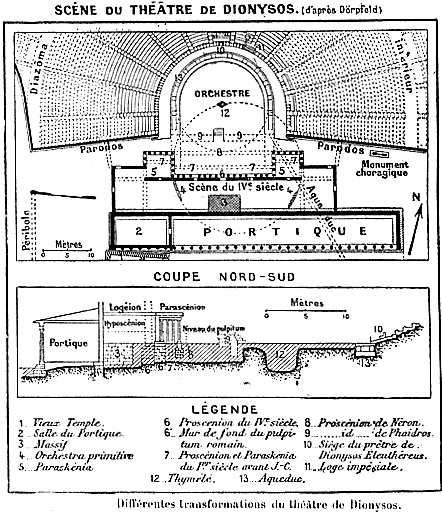 |
The theatre at Athens, like other Greek theatres, consisted of three chief parts : (I) the auditorium or seats of the audience, (II) the orchestra, and (III) the stage-buildings.
- The auditorium faces south, the seats rising above each other, on the slope of the Acropolis, in tiers which may be roughly described as semicircular. At the extremities of the two wings, however, on the east and west, artificial substructions were necessary in order to bring up the back seats to the proper height. The retaining-walls on the western side are preserved. They are two in number, an inner and an outer, united by short cross-walls at right angles. The inner wall is built of conglomerate and formed the real support of the scats in this part. The outer wall is of Piraeic limestone and served merely to cover and protect the inner wall. On the eastern side of the theatre the retaining walls have almost disappeared. The outer boundary of the auditorium seems to have formed three-quarters of a circle, the two ends being prolonged in straight lines. The breadth across from the outer corner of one wing to the outer corner of the other wing was z88 feet. The distance between the inside corners, measured across the orchestra, was 72 feet. The wings are of unequal width, the eastern wing measuring about 111 feet across at its southern extremity, while the western wing measures only 88 feet. This makes the arrangement of the theatre unsymmetrical. The seats in the highest part of the theatre, immediately under the cliff of the Acropolis, are hewn out of the rock. The rest were made of Piraeic limestone, except the front row which consisted of marble chairs. Most of the seats have disappeared, having been probably removed in the Middle Ages to furnish building materials. However, from twenty to thirty of the bottom rows remain, and portions of a few rows at the top. Of the sixty-seven chairs of Pentelic marble which formed the front row, immediately encircling the orchestra, fiftyeight have been found, all of them, with the exception of two or three, in their original places. Most of these chairs, as we learn from the inscriptions carved on them (C.I.A. III. Nos. 240-298), were reserved for special priests or priestly functionaries ; the rest were set apart for the higher magistrates, such as the king, the commander-in-chief (Polemarch), and the lawgivers (Thesmothetae). The arm-chair in the middle of the row, the largest and finest of all the chairs, was reserved for the priest of Eleutherian Dionysus. It is adorned with elegant sculptures in low relief. On the back of the chair, above the seat, are carved two satyrs, standing back to back in heraldic style, supporting a large cluster of grapes between them. On the outside of each arm of the chair is sculptured a winged figure stooping and holding a cock which he is about to let go for the fight. These latter reliefs, which are very graceful and delicate, probably refer to the cock-fight which, as we have seen, took place annually in the theatre. On the front part of the chair, immediately below the seat, are carved two winged lions fighting with two men who, dressed in long Oriental garments and wearing Phrygian caps, are kneeling and defending themselves with scimitars against the lions. This last design is clearly borrowed from the East, and in point of style seems to belong to the second century of our era (see Beulé, in Revue archéologique, N.S. 6 (1862), p. 349 sq. ; G. Perrot, in Bulletin de Corr. Hellén. 5 (1881), pp. 23-25). It is calculated that the rows of scats were originally about 100 in number, and that the number of spectators which the theatre could accommodate was 27,500. Plato speaks in round numbers ofover 30,000 spectators witnessing a play of Agathon (Symposium, p. 175 e). Access to the seats in the upper rows were afforded by fourteen passages which ran in divergent lines, like the spokes of a wheel, from the orchestra up to the top of the theatre. Two of these passages, at the southern extremities of the wings, immediately adjoined the boundary walls ; the other twelve divided the whole mass of the seats into thirteen wedge-shaped blocks, such as the Latins called cunei («wedges») and the Greeks kerkides. In addition to these vertical passages there seems to have been one horizontal passage in the higher part of the auditorium, dividing it into an upper and a lower portion. This horizontal passage or diazoma («belt, girdle»), as the Greeks called it, is marked on a rude representation of the theatre which is stamped on some Athenian coins (Imhoof-Blumer and Gardner, Num. Comm. on Paus. p. 143, with pl. CC, IX. x.)
In regard to the date of the auditorium, Dr. Dörpfeld, the most competent living authority on such subjects, is of opinion that all the existing remains belong to the second hall of the fourth century B.C., when the theatre was built or rebuilt by Lycurgus. The inscriptions on the marble chairs are, indeed, later ; but the chairs themselves seem to be of the age of Lycurgus. Dr. Dörpfeld is reported to hold the view that, in spite of the tradition preserved by Suidas (see above), there was no permanent stone theatre at Athens before that date. This view is to some extent borne out by the evidence of Andocides who speaks (I. 38 sq.) of an orchestra only, not of a theatre, in the precinct of Dionysus ; and by the evidence of Thucydides (VIII. 93 sq.) and Demosthenes (XXI. 8 sq., p. 517 sq.) who, speaking of public assemblies held in the precinct of Dionysus, make no mention of a theatre - an omission all the more noticeable in that Thucydides in the same chapter (VIII. 93) has mentioned a public assembly held in «the Dionysiac theatre» at Munychia. - The orchestra or «dancing-place» was the flat ground enclosed between the stage-buildings and the seats of the auditorium. In the theatre at Athens the orchestra is in the form of a semicircle with the two ends prolonged in straight lines. Its width, measured along the front of the stage of Phaedrus, is 24 metres (about 78 feet 6 inches) ; and its depth from the middle of the stage-front of Phaedrus to the boundary in front of the chair of the priest of Dionysus, in the centre of the first row of spectators, is 17.96 metres (about 58 feet 6 inches). It 1s paved with slabs of Pentelic and Hymettian marble arranged in lines parallel to the stage, and variegated with strips of a reddish marble. In this pavement, about the middle of the orchestra, but somewhat nearer its southern than its northern boundary, is a large rhombus or diamond-shaped figure, the outline of which is formed by lines of Pentelic and Hymettian marble, while its interior is paved with diamond-shaped pieces of Pentelic, Hymettian, and reddish marble. In the centre of this figure is a block of Pentelic marble in which is cut a shallow circular depression, possibly intended to receive an altar or image of Dionysus. The pavement is of excellent workmanship, and perhaps dates from the first century of our era. The orchestra is divided from the seats of the auditorium by a parapet composed of upright slabs of marble 3 feet 7 inches high. Along the inside of this parapet and separated by it from the seats, there runs a broad gutter of limestone 35 inches in width. This gutter was originally open except that opposite the vertical passages which lead through the tiers of seats it was bridged with slabs of limestone. In later times it was covered over with marble slabs. The intention of this gutter, which forms part of the original building, was to drain off the water from the auditorium ; but this intention was frustrated by the erection, at a later time, of the marble parapet which divides the orchestra from the auditorium. The parapet and the marble covering of the gutter belong, according to Dr. Dörpfeld, to the beginning of the third century A.D. It is conjectured that the parapet may have been erected to prevent the vanquished gladiators from being actually butchered on the laps of the dignitaries who sat in the front row, as sometimes happened in the days of Dio Chrysostom (Or. XXXI. vol. I. p. 386, ed. Dindorf).
Access was afforded to the orchestra by two side-entrances consisting of two open passages, 9 feet wide, which divided the wings of the auditorium from the stage-buildings. By these passages the spectators entered the orchestra, whence they ascended by the vertical passages to their seats ; and by these same passages the chorus entered the orchestra at the beginning of each play. Such passages or sideentrances into the orchestra were called parodoi (Schol. on Aristophanes, Knights, 149 ; Pollux, IV. 126) or eisodoi (Schol. on Aristophanes, Birds, 296).
The original orchestra, which existed before the theatre was built, seems to have been a flat circular space enclosed by a low wall. Two portions of this wall, built of rough polygonal stones, and forming two arcs of the circle, still exist among the later stage-buildings ; and a cutting in the rock which forms an arc in the same circle and in which doubtless another piece of the circular enclosing wall was bedded, may be seen in the eastern side-entrance (parodos) to the orchestra, at the point where the stage of Phaedrus abuts on the seats of the auditorium. The discovery and explanation of these interesting remains are due to Dr. Dörpfeld. - The existing remains of the stage-buildings are of various dates. Dr. Dörpfeld distinguishes four sets of stage-buildings constructed at different times : (1) The stage-buildings of Lycurgus consisted of a long rectangular hall with two projecting wings, each 7 metres (23 feet) wide by 5 metres (16 feet 5 inches) deep. In the space between the wings, about 66 feet long, was set up the scenery ; it was of wood and canvas and was taken down when the performances were over. There was at this time, if Dr. Dörpfeld is right, no permanent stone stage. (2) At a later time, perhaps in the Roman period, a piece was taken off the front of each wing, and a permanent scene or background, adorned with columns and probably 10 or 12 feet high, was erected between the wings. But even when this permanent background was erected, there was still (according to Dr. Dörpfeld) no stage. (3) In the reign of Nero a stage was built further to the front, encroaching on the orchestra. Slight traces only of its front wall remain ; but of the back wall there are more remains. Fragments of the arches and pillars of Hymettian marble which adorned this stage have been found. (4) Lastly, in the course of the third century A.D. a certain Phaedrus erected a new stage about 8 yards further to the front, so as to stretch across the orchestra between the inner corners of the two wings of the auditorium, thus completely blocking up the side-entrances (parodoi) into the orchestra. Of this later stage the western half is preserved. It is low, after the Roman fashion, its height being only 4 feet 7 inches. In the middle a flight of five steps led down into the orchestra. On the top step, as has been mentioned already, is carved the inscription (C.I.A. III. No. 239) recording the erection of the stage. The front of the existing half of this stage is adorned with four groups of figures in high relief. These reliefs are clearly of older date and better workmanship than the stage which they adorn ; and the clumsy way in which the slabs have been cut down and fitted into their present position shows that they were not made for it. The heads of the figures are lost ; when they were in their places they must have been higher than the background. One of the groups represents the birth of Dionysus ; another represents Icarius, attended by his daughter Erigone, about to sacrifice a goat to Dionysus ; in the background crouches the faithful dog Maera (Apollodorus, 14. 7 ; Hyginus, Fab. 130). The interpretation of the other two groups is uncertain. (See F. Matz, «I rilievi del proscenio del teatro di Bacco in Atene», Annali dell' Instituto, 42 (1870), pp. 97-106.) The reliefs are divided into two pairs of groups by a deep niche in which is the crouching figure of a Silenus. To the east of the steps a second Silenus, the companion of the other, has been found. It doubtless occupied a corresponding niche in the eastern half of the stage-front. These sculptures apparently date from the early period of the Roman empire ; they perhaps belonged originally to the stage which was built in the reign of Nero.
See Dyer, Ancient Athens, pp. 307-343 ; Leop. Julius, «Das Theater des Dionysos zu Athen», Zeitschrift fur bildende Kunst, 13 (1878), pp. 193-204, 236-242 ; Praktika tês archaiologikês Etairias for 1877, pp. 6, 18 sq.; id., for 1878, p. 8 sqq.; J. R. Wheeler, «The theatre of Dionysus», Papers of the American School of Classical Studies at Athens, vol. 1. (1882-1883), pp. 123-179 ; Milchhöfer, Athen, pp. 190-192 ; Albert Müller, Die griech. Bühnenalterthümer, pp. 82-loi ; W. Dörpfeld, ib. p. 415 sq. ; G. Kawerau, article «Theatergebäude», in Baumeister's Denkmäler, pp. 1734-1738 ; Guide-Joanne, 1. pp. 69-72 ; Baedeker, pp. 53-55 ; A. Bötticher, Die Akropolis von Athen, pp. 236-245 ; A. E. Haigh, The Attic Theatre, ch. III. pp. 1o1-163 ; Miss Harrison, Ancient Athens, PP. 271-295.
(9) Statues of tragic and comic poets of little mark. Astydamas, a writer of voluminous tragedies, was allowed to set up a statue of himself in the theatre ; the inscription which he caused to be carved on it was so boastful that his name became proverbial (Suidas, s.v. sautên epaineis ; as to the poet, see id., s.v. Astudamas o presbutês). His statue was of bronze and was set up sooner than that of Aeschylus (Diogenes Laertius, II. 5. 43). Dio Chrysostom mentions the bronze statue of a poetaster which stood cheek by jowl with the statue of Menander in the theatre at Athens (Or. XXXI. vol. 1. p. 384 lines 4-6, ed. Dindorf). We hear of a statue of a nobody called Euryclides which stood in company with the statues of Aeschylus and his fellows in the same place (Athenaeus, I. p. 19 e). Others besides poets and poetasters had statues in the theatre. There were statues of Themistocles and Miltiades, the former on the right, the latter on the left ; and beside each of them was the statue of a Persian captive (Aristides, Or. XLVI. vol. 2. p. 215 sq., ed. Dindorf ; Schol. on Aristides, l.c. vol. 3. p. 535 sq., ed. Dindorf). The bronze statue of a general, beside which the trembling Dioclides crouched as he watched the impious crew at their moonlight revels in the orchestra (Andocides, I. 38), may have been the statue of Themistocles or the statue of Miltiades. It appears that twelve statues of the emperor Hadrian were set up in the theatre by the twelve Attic tribes, one statue by each tribe ; and that these statues stood one in each of the wedge-shaped blocks of seats, except in the central block. The inscriptions on the bases of four of these statues have been found in the theatre (C.I.A. III. Nos. 466-469). In the central block of seats was found the inscription from the base of a thirteenth statue of Hadrian, which had been set up by the Council of the Areopagus, the Council of the Six Hundred, and the Athenian people (C.I.A. III. No. 464). See Milchhöfer, Athen, p. 191 ; Papers of the American School of Classical Archaeology, I (1882-1883), PP. 149-151.
(10) Menander. The pedestal of this statue was found built into a late wall at the back of the stage. It is of Pentelic marble, and bears the inscription :
Menandros
Kêphisodotos Timarchos epoêsan
«Menander. Cephisodotus and Timarchus made (the statue)» (C.I.A. II. No. 1370 ; Loewy, Inschriften griech. Bildhauer, No. 108). It has been conjectured that a fine seated statue of Menander in the Vatican (Baumeister's Denkmäler, p. 923, fig. 995) is no other than the statue which stood in the theatre at Athens, and of which the inscribed pedestal has been found. But the shape and size of the pedestal differ from those of the plinth on which the statue rests. See P. Pervanoglu, in Bulletino dell' Instituto, for 1862, pp. 163-165 ; R. Förster, in Archäologische Zeitung, 32 (1875), p. 100 sq. ; Loewy, i.e. ; Overbeck, Gesch. d. griech. Plastik,4 2. p. 112 sq. The sculptors Cephisodotus and Timarchus were sons of Praxiteles. See note on IX. 12. 4.
(11) Among the famous tragic poets there are statues of Euripides and Sophocles. Bronze statues of Aeschylus, Sophocles, and Euripides were set up on the motion of the statesman Lycurgus ([Plutarch,] Vit. X. Orat. p. 841 f). It was probably these statues which Pausanias saw in the theatre. If so, he was right in conjecturing (§ 2) that the statue of Aeschylus had been erected long after the poet's death. The statue of Aeschylus is mentioned by Athenaeus (I. p. 19 e) and Diogenes Laertius (II. 5. 43) in passages which have been already referred to (see note on § I Statues of tragic and comic poets). It is hardly necessary to say that, though Pausanias does not mention Aeschylus in the present sentence, he does not intend to exclude him from the list of famous tragic poets. After mentioning two of the great tragic dramatists, Euripides and Sophocles, our author stops to tell parenthetically an anecdote about Sophocles ; he then resumes and concludes the list with the mention of the statue of Aeschylus. F. G. Welcker understood the present passage of Pausanias in this sense (Alte Denkmäler, 1. p. 465 sq.) He rightly combats Wieseler's view that in Pausanias's time there was no statue of Aeschylus in the theatre.
(12) It is said that after the death of Sophocles etc. The following anecdote is told more fully by the anonymous author of the life of Sophocles (Biographi Graeci, ed. Westermann, p. 13o) as follows : «He was laid in the grave of his fathers on the road to Decelea, eleven furlongs from the walls. Some say that a Siren, others that a bronze swallow, was placed on his tomb. When the Lacedaemonians had fortified this place against the Athenians, Dionysus appeared in a dream to Lysander, and bade him suffer the man to be laid in the grave. As Lysander paid no heed to the injunction, Dionysus appeared to him a second time with the same command. So when Lysander inquired of the exiles who it was that had died, and learned that it was Sophocles, he sent a herald with leave to bury him». A few years ago there was excavated, a mile and a half from Palaiokastron (Decelea), a family tomb which was reported to be the tomb of Sophocles. It contained three funeral urns, which, from the objects found in them (a mirror and two strigils), appear to have enclosed the ashes of a woman and two young men. But there were no inscriptions to identify the tomb as that of Sophocles, and the proposed identification appears to have been based on the mistaken supposition that the tomb o Sophocles was situated eleven furlongs from Decelea, instead of (as the anonymous author of the life of Sophocles clearly implies) from Athens. See Berliner philolog. Wochenschrift, 8 (1888), p. 1074 ; id., 13 (1893), p. 1648 sqq.
(13) A gilded head of the Gorgon Medusa etc. This was set up by King Antiochus ; the aegis as well as the Gorgon head was gilt. See V. 1. 42. Placed in this prominent position on the wall of the Acropolis the Gorgon head was probably intended to serve as a charm against the evil eye. The stone head of Medusa beside the sanctuary of Saviour Zeus at Argos (II. 2o. 7) may have been placed there with a like intention, Cp. O. Jahn, «Ueber den Aberglauben des bösen Blicks bei den Alten», Berichte über die Verhandl. d. k. sächs. Gesell. d. Wissen. zu Leipzig, Philog. histor. Cl. 1855, p. 28 sqq., especially p. 59 sq. ; A. Milchhöfer, «Gorgoneion», Archäologische Zeitung, 39 (1881), pp. 281-293. With the same intention the ancients sometimes carved a phallic symbol on the walls of their cities : such symbols may still be seen carved on the walls of ancient cities (as Alatri and Ferentino) in Italy and Africa (O. Jahn, op. cit. p. 74 ; Perrot et Chipiez, Hist. de l'art dans l'antiquité, 6. p. 804). With this Greek use of a charm to avert the evil eye from buildings we may compare a similar Hindu superstition. Lieut. Burnes writes as follows of a Jain temple which he visited at Abu in Guzerat : «While admiring its beauty I observed the capital of one of the pillars to be of coarse unpolished black stone, which induced me to ask the cause of such a disfiguration ; when the people informed me that it had been done intentionally to keep off the evil eye, as in a place like this where all was beauty, it would inevitably fall and become bewitched if there was no foil» (Journal of the Asiatic Society of Bengal, 2 (1833), p. 164).
(14) At the top of the theatre is a cave in the rocks etc.
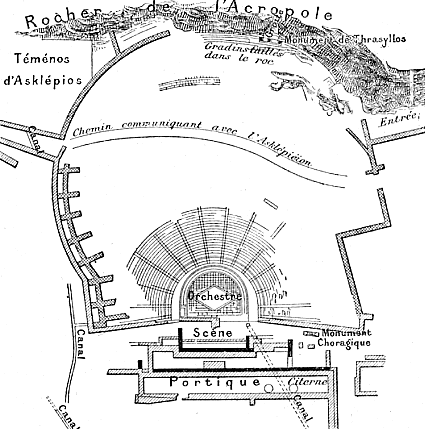
This cave is still to be seen in the rock of the Acropolis, immediately above the theatre. It is about 23 feet wide and 50 feet deep. The floor of the cave is at two different levels ; the back part of it is higher than the front part, and is reached by steps cut in the rock. The cavern has long been a chapel dedicated to the Virgin of the Cave (Panagia Spiliotissa) or the Virgin of the Golden Cave (Panagia Chrysospiliotissa), whose solitary light, when darkness has fallen, may be seen glimmering high up on the side of the Acropolis. On the walls of the cave are some faded Byzantine paintings. Down to the beginning of this century the mouth of the cave was adorned by a Doric portico, forming the choregic monument of Thrasyllus. This elegant little structure, about 29 feet 5 inches high by 25 feet wide, consisted of three Doric pilasters resting on two steps and supporting an epistyle, which was in turn surmounted by a frieze adorned with eleven marble wreaths carved in relief. Thus much of the structure was built of white Pentelic marble. Above the frieze were three pedestals of gray marble ; the central one, resting on three steps, supported a seated statue, of more than life-size, which is now in the British Museum. The statue, which had lost its head as early as 1676, is draped in a long robe, and has a panther's skin thrown over the shoulders ; it is supposed to represent Dionysus. The space between the pilasters, originally no doubt open, was blocked up with a modern wall, which may have been built when the cave was turned into a church. A door in this wall afforded the only access to the cave, which was dimly lighted by two small openings in the same wall. Three inscriptions were carved on the front of the monument. One of them (C.I.A. II. No. 1247) engraved on the middle of the epistyle, under the frieze, set forth that the monument was dedicated by Thrasyllus of Decelea, son of Thrasyllus, in commemoration of a victory which he had won with a chorus in the archonship of Neaechmus (320/119 B.C.) The other two inscriptions (C.I.A. II. Nos. 1292, 1293) carved on the two pedestals to the right and left of the central pedestal, which supported the statue of Dionysus, commemorate two victories won by choruses furnished by the state in the archonship of Pytharatus (271/70 B.C.), when Thrasycles of Decelea, son of Thrasyllus, was president of the games (agonothetes). The monument, after being seen and described by Wheler, Stuart, Chandler, and Dodwell, was destroyed during the siege of the Acropolis by the Turks in the years 1826 and 1827. But the two last-mentioned inscriptions, with a piece of the first, may still be seen lying on the ground to the right and left of the cave, though the block on which one of them (C.I.A. II. No. 1293) was engraved is broken in three.
As the monument was erected to commemorate a choregic victory, it doubtless supported a prize tripod (see I. 20.1 note), which, being directly over the entrance to the cave, must have been the one seen by Pausanias. In the lap of the statue which surmounted the monument there is a hole in which, it has been conjectured, the tripod was fixed. But such a way of supporting a tripod seems to be without parallel ; it is more likely that the statue was enclosed within the legs of the tripod, according to the usual fashion of these monuments (I. 20. I note). It has, indeed, been suggested that the whole upper part of the monument, consisting of the three pedestals and the statue of Dionysus, was a later addition made by Thrasycles, who removed his father's prize tripod, and substituted for it the statue of Dionysus. But in addition to the improbability that Thrasycles should have removed a trophy which reflected honour on his family, we have the positive evidence of Pausanias that the tripod was there in his day, three centuries after the time of Thrasycles. The fact that the upper part of the monument is constructed of a different sort of marble from the lower is no proof that it is a later addition. The choregic monument of Lysicrates is similarly constructed of two sorts of marble (Eleusinian and Pentelic) ; but nobody for that reason supposes that the upper part is a later addition.
The other two pedestals may have supported two other tripods set up by Thrasycles in memory of the two choregic victories won under his presidency in 271/70 B.C. But as Pausanias mentions only one tripod, it may be that Thrasycles contented himself with engraving two commemorative inscriptions on his father's monument, without setting up tripods also. Neither of his two inscriptions mentions a tripod or even a dedication of any kind. It should be remembered that he had hot, like his father Thrasyllus, furnished the chorus himself ; the chorus had been furnished by the people, and Thrasyllus had only superintended it ; to speak technically, he had been agonothetes, not choregos. Now, though it was certainly the custom for a choregos to set up the prize tripod which he had received for a choral victory, it is not certain that it was the custom for an agonothetes to do so. Professor U. Köhler has, indeed, inferred that the obligation was binding on the agonothetes as well as on the choregos ; but the passage of the inscription on which he bases this inference is mutilated (see Mittheilungen d. arch. Inst. in Athen, 3 (1878), p. 234).
Pausanias's expression «in it» (en autô) leaves us uncertain whether the group of Apollo and Artemis slaying the children of Niobe was in the cave or in (i.e. enclosed by the legs of) the tripod. If, as seems probable, the statue of Dionysus was enclosed by the legs of the tripod, it would follow that the group of Apollo, Artemis, and the children of Niobe was in the cave, or perhaps rather in the portico. It has indeed been sometimes supposed, as by Prof. Milchhöfer, that the group was represented in relief on the tripod ; but this supposition seems excluded by Pausanias's language. If he had meant to describe the group as a relief on the tripod he would have said not «in it» (en autô), but «on it» (ep'autô) and would probably have added the participle epeirgasmenoi.
The face of the rock on both sides of the cave has been chiselled into a smooth perpendicular surface. Two large niches are cut in it immediately to the west of the cave. On the steep slope above the cave, at the foot of the wall of the Acropolis, are still standing two high columns of Hymettian marble, with triangular Corinthian capitals. These columns, which are of unequal height, originally supported tripods ; the holes in which the feet of the tripods were fastened can be perceived on the top of the triangular capitals by looking clown at them from the wall of the Acropolis. To the east of these columns some votive inscriptions, much weathered and defaced, may be seen carved on the rock. The perpendicular cutting in the face of the rock, with its niches and inscriptions, is doubtless what the ancients called the Katatome or «scarp». Hyperides spoke of a man «seated under the scarp» ; and Philochorus mentioned that a certain Aeschraeus, «having gained a victory with a chorus of boys, dedicated a silver-plated tripod above the theatre, and carved an inscription on the scarp of the rock» (Harpocration, s.v. katatomê ; cp. Pollux, IV. 123).
See Wheler, Journey, pp. 368-370 ; Stuart and Revett, Antiquities of Athens, 2 (London, 1787), 29-36, with plates I.VI. ; Chandler, Travels in Greece, pp. 62-64 ; Dodwell, Tour in Greece, 1. pp. 299-301 (with a view of the interior of the cave) ; Leake, Athens, 1. p. 186 ; Wordsworth, Athens and Attica, p. 76 sq. ; W. Vischer, Erinnerungen und Eindrücke, p. 173 sq. ; K. B. Stark, Niobe und die Niobiden, pp. 111-118 ; Dyer, Ancient Athens, pp. 336-341 ; Milchhöfer, Athen, p. 193 ; Baedeker,3 p. 56 ; Guide-Joanne, 1. p. 72 ; E. Reisch, «Zum Thrasyllosmonument», Mittheil. d. arch. Inst. in Athen, 13 (1888), pp. 383-401; Lolling, Athen, p. 328 ; Miss Harrison, Ancient Athens, pp. 266-271 ; A. H. Smith, Catalogue of Sculpture in the British Museum, 1. pp. 257-259.
(15) This Niobe I myself saw when I ascended Mount Sipylus. Cp. VIII. 2. 7, and see note on V. 13. 7.